In an advertising landscape dominated by social media, search, streaming and digital screens, it can be easy to assume that traditional advertising formats have been left behind.
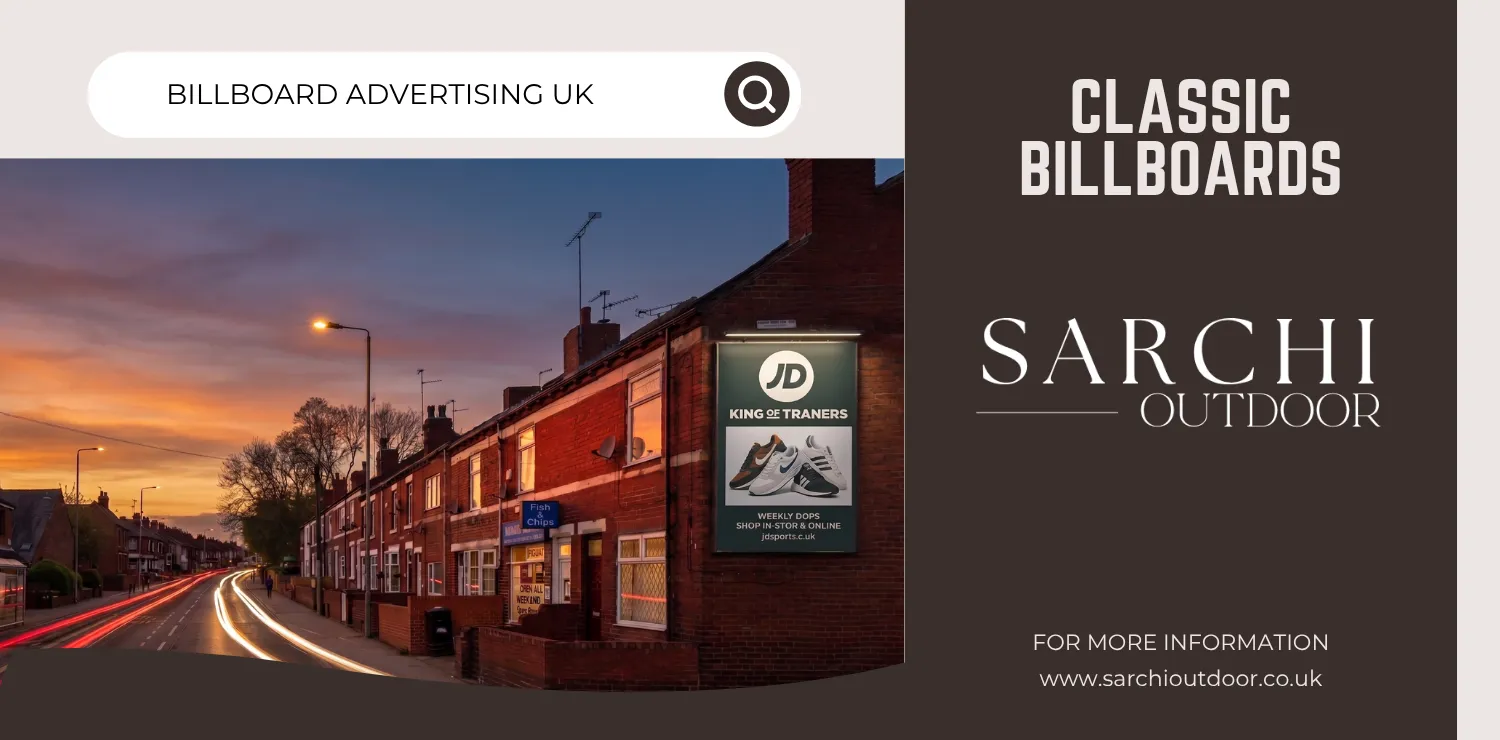
But static, or “classic”, Out-of-Home (OOH) advertising tells a very different story.
Traditional billboards remain one of the most powerful ways for brands to achieve mass visibility, build recognition and put their message directly into the real world. And the latest UK industry figures show that static OOH is not disappearing. It continues to attract significant advertiser investment and remains an important part of the UK media landscape.
Classic OOH Is Still Growing
The latest figures from Outsmart, the UK trade body for Out-of-Home advertising, provide a strong indication of the health of the medium.
In 2025, total UK OOH advertising revenue reached a record £1.44 billion, representing 2.6% year-on-year growth and the highest annual revenue ever recorded for the sector.
While digital OOH continues to grow rapidly, classic OOH also increased by 1.3% during 2025. In the fourth quarter alone, classic OOH revenue remained positive, growing by 0.3%.
This is important because the growth of digital advertising has not resulted in the disappearance of traditional billboards. Instead, classic and digital OOH continue to operate alongside one another, giving advertisers different ways to reach audiences in the physical world.
In fact, Q3 2025 demonstrated just how resilient classic OOH can be. Classic OOH revenue increased by 6.5% year-on-year during the quarter, outperforming digital OOH growth of 3.3%.
Billboards Deliver Something Digital Advertising Can’t
One of the biggest advantages of a static billboard is its physical presence.
A billboard cannot be skipped, blocked or closed with a click. It sits within the environment and becomes part of the journey people make every day.
Whether that is a commuter driving to work, a shopper travelling towards a retail destination or a family travelling through a town or city, a well-positioned billboard can repeatedly expose audiences to the same brand message.
According to Route, the UK’s Joint Industry Currency for OOH audience measurement, OOH reaches 97% of the UK population every week. Route’s measurement system uses GPS tracking, demographic information, eye-tracking and volumetric data to understand who sees OOH advertising and how often.
The scale is therefore significant. Static billboards form part of a medium capable of reaching almost the entire UK population every week.
Static Billboards Build Brand Recognition
Advertising is not simply about generating an immediate click.
For many brands, the objective is to become familiar, memorable and recognisable to consumers over time.
This is where static billboards can be particularly effective.
A strong piece of billboard creative can remain in the same location for weeks or months, giving brands the opportunity to build repeated exposure. Instead of constantly changing the message, advertisers can create a consistent visual association between a location and their brand.
That consistency can be particularly valuable for businesses looking to build long-term brand awareness.
OOH also benefits from the fact that consumers encounter advertising while they are physically out in the world. The IPA notes that OOH can reach more than 90% of the GB population each week in isolation, giving it exceptional mass reach in an increasingly fragmented media environment.
Static Doesn’t Mean Outdated
One of the biggest misconceptions about classic billboards is that “static” means old-fashioned.
It doesn’t.
The technology behind advertising may have changed dramatically, but the fundamental principle remains the same: put the right message in front of the right people in the right location.
Modern OOH planning allows advertisers to use audience data, location information and sophisticated measurement to identify the most relevant sites for a campaign.
Route now provides audience data for approximately 400,000 posters and screens across Great Britain, with data updated quarterly. This means advertisers can make increasingly informed decisions about where they place their campaigns, even when the physical advertising format itself is completely static.
The billboard may not move, but the strategy behind it has evolved significantly.
Static Billboards Can Also Be Extremely Creative
There is another major advantage to static OOH: creativity.
A billboard gives brands a large physical canvas and the opportunity to create something that consumers can recognise instantly.
The best campaigns don’t need complicated technology or animation. They use strong imagery, distinctive branding and simple messaging to communicate an idea in seconds.
Research and industry case studies continue to demonstrate the wider effectiveness of OOH campaigns. For example, an effectiveness study by JCDecaux, Clear Channel and Posterscope found that contextual relevance in OOH advertising increased advertising recall by 17% and sales by 16% in the study.
And OOH campaigns can create results well beyond awareness. A recent UK campaign for Abel & Cole used static and digital OOH alongside other channels and reported a 17.1% sales uplift in London and 12.1% in the Meridian region following independent analysis.
Static and Digital OOH Don’t Have to Compete
The growth of digital OOH is sometimes presented as though it is replacing traditional billboards.
The reality is more nuanced.
In 2025, digital OOH accounted for 67% of total UK OOH revenue, but that still leaves a significant proportion of the market in classic OOH. Classic billboards continue to provide something digital cannot always replicate: a permanent, uninterrupted presence.
For many campaigns, the strongest strategy may actually be to use both.
Digital OOH can provide flexibility, dynamic messaging and time-sensitive creative, while static billboards can provide consistency, scale and long-term visibility.
The two formats can complement one another rather than compete.
Why Brands Should Still Consider Static Billboards
For advertisers considering their next UK campaign, static billboards continue to offer several compelling advantages.
They provide mass reach. They offer repeated exposure. They create a physical presence for brands. They cannot be skipped. They work particularly well for simple, memorable creative and they can be extremely cost-effective when the right locations are selected.
And perhaps most importantly, they are still being bought.
The fact that classic OOH generated positive revenue growth in 2025, while the wider OOH market reached its highest-ever annual revenue, demonstrates that advertisers continue to see value in the format.
The Future of Billboard Advertising Is Not Just Digital
Digital advertising will continue to evolve, and digital OOH will undoubtedly remain an important part of the industry’s future.
But that doesn’t mean static billboards have had their day.
Quite the opposite.
In an increasingly fragmented media environment, where consumers are exposed to thousands of digital messages every day, there is something powerful about a large, physical advertisement that simply exists in the real world.
Static billboards remain visible, memorable and capable of delivering enormous reach.
For brands that want to be seen, remembered and associated with the places where consumers live, work and travel, classic OOH remains an incredibly effective medium.
At Sarchi Outdoor, we provide access to a growing portfolio of static billboard sites across the UK, with formats ranging from 16 sheets through to 96 sheets.
If you’re looking to build brand awareness, reach local audiences or deliver a nationwide OOH campaign, contact Sarchi Outdoor to find out what sites are currently available.
Email: info@sarchioutdoor.co.uk
Sources: Outsmart, Route, IPA and WARC. Statistics and industry figures referenced above are based on the latest publicly available information at the time of publication.